Articles
Person-Centred Design Principles for Robust Specialist Disability Accommodation in Australia
Person-Centred Design Principles for Robust Specialist Disability Accommodation in Australia
Specialist Disability Accommodation, known as SDA, provides purpose-built housing for NDIS participants with significant functional impairments or high support needs. Within the SDA framework, the robust design category addresses participants who may exhibit behaviours of concern. These behaviours can be triggered by environmental factors, making thoughtful design essential for safety, dignity and positive outcomes.
The NDIS SDA Design Standard, first released in 2019, sets clear expectations for all design categories. Robust SDA goes further by requiring designs that actively support residents while protecting staff and neighbours. Success depends on placing the individual at the centre of every decision.
Why a Person-Centred Approach Matters
Person-centred design starts with genuine understanding of each resident. It recognises that every person has unique preferences, triggers and goals. When design teams listen first and design second, the resulting homes reduce incidents, improve quality of life and deliver better value for providers and investors.
Research and practice across Australia show that robust SDA performs best when it feels like a real home rather than an institution. Residents who have choice and control experience greater independence, stronger relationships and improved mental health. Providers benefit from lower staff turnover and reduced property damage.
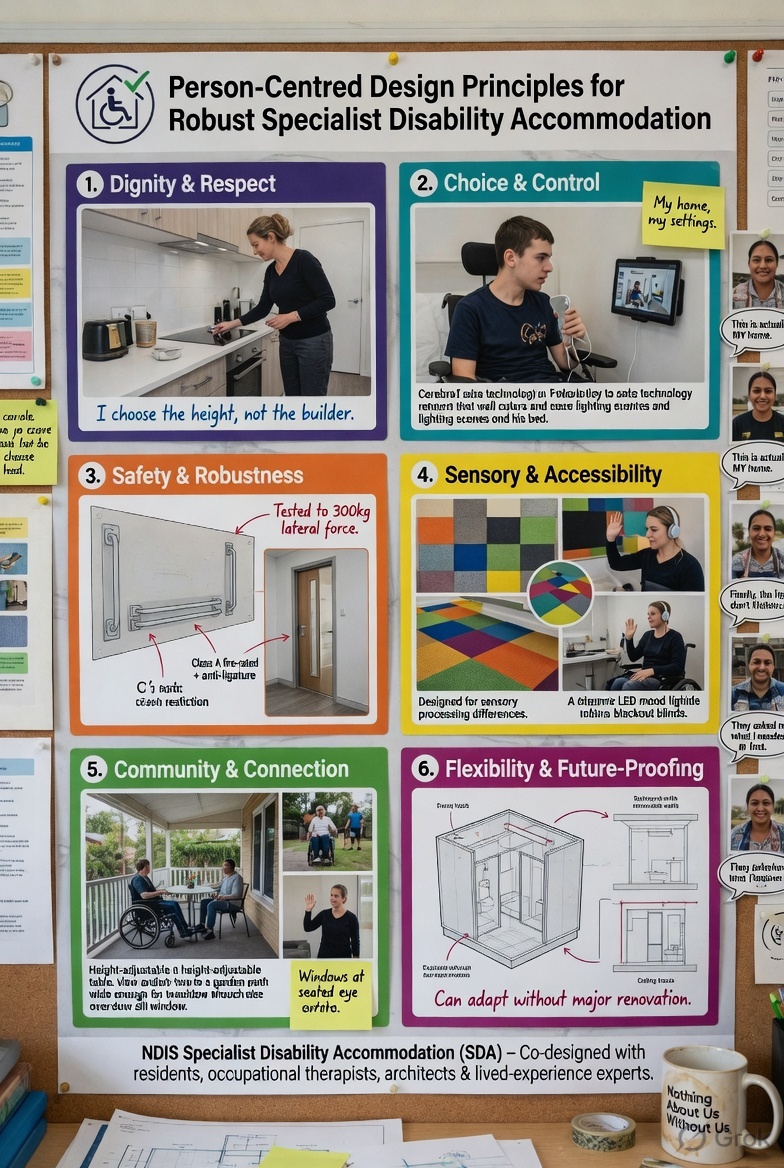
Seven Core Design Principles for Robust SDA
The following principles, drawn from leading Australian guidance on robust SDA, provide a practical framework for architects, developers and access consultants.
1. Enable a Person-Centred Co-Design Approach
Involve future residents, families and support teams from the earliest concept stage. Use real-life scenarios and sensory profiles to test every design choice. This collaborative process uncovers hidden needs that standard templates miss.
2. Create a Homelike Space
Avoid clinical finishes and institutional layouts. Use domestic-scale rooms, familiar materials, natural light and private outdoor areas. A homelike environment lowers anxiety and helps residents feel safe and valued.
3. Maximise Independence and Freedom
Design for the highest possible level of autonomy within safe boundaries. Wide, clear pathways, intuitive controls, private bedrooms with lockable doors and accessible bathrooms all support dignity and self-reliance.
4. Maximise Safety and Comfort
Identify and mitigate environmental triggers such as excessive noise, harsh lighting, sharp corners or confined spaces. Incorporate calming colour palettes, acoustic treatments and robust yet attractive fixtures that withstand wear without looking institutional.
5. Support Choice and Options for Interaction
Provide flexible spaces that allow residents to choose between solitude and social engagement. Quiet retreat areas, small group living zones and adaptable communal spaces respect individual preferences and changing daily needs.
6. Enable Effective Support Delivery
Design staff facilities, medication storage, quiet offices and clear sightlines that support high-quality care without compromising resident privacy. Good support infrastructure reduces stress for both residents and workers.
7. Deliver Adaptable and Flexible Design
Build in future-proofing. Modular layouts, adjustable fixtures and spaces that can be reconfigured as resident needs evolve protect long-term investment and minimise costly retrofits.
Alignment with the NDIS SDA Design Standard
These principles complement the requirements of the NDIS SDA Design Standard. The Standard emphasises performance outcomes rather than rigid prescriptions, giving skilled designers room to innovate while meeting certification benchmarks. When person-centred robust principles are applied early, projects achieve faster approvals, smoother certification and stronger long-term performance.
Practical Outcomes for Australian Projects
Developers and architects who embrace these principles report fewer behavioural incidents, higher occupancy rates and stronger relationships with NDIS participants and their families. Robust SDA that feels like home also attracts and retains quality support staff, a critical factor in regional and metropolitan markets alike.
Our Experience Delivering Person-Centred Robust SDA
Sydney Access Consultants has supported numerous SDA projects across New South Wales, applying these exact principles from concept through to certification. Our team understands both the technical requirements of the NDIS SDA Design Standard and the human factors that determine real-world success.
On the Mid North Coast of NSW, our local access consultant Sandy Gray works directly with regional clients and communities. Based at Black Beach, Sandy provides on-the-ground expertise for projects that need practical, place-sensitive solutions while meeting national SDA benchmarks.
We also assist clients in Perth and throughout Western Australia. Our advice respects local planning contexts, community expectations and the distinct character of Western Australian projects, delivering inclusive outcomes without imposing a one-size-fits-all approach.
Whether your project is a new group home, a robust SDA dwelling or a larger residential development incorporating SDA, early engagement with qualified access consultants ensures the design meets both regulatory requirements and the deeper needs of future residents.
Next Steps for Your SDA Project
Applying person-centred robust design principles from the outset reduces risk, improves participant outcomes and strengthens your project’s long-term value. Our team brings deep experience across the full spectrum of SDA categories and is ready to partner with architects, developers and providers nationwide.
Expert Evidence in Access Consulting and Architectural Disputes: Lessons from Makita v Sprowles

Expert Evidence in Access Consulting and Architectural Disputes: Lessons from Makita v Sprowles
At Sydney Access Consultants, we prepare detailed reports for clients, councils, certifiers and tribunals on Specialist Disability Accommodation (SDA) compliance, access audits, and building design issues. When those reports are used in NCAT, the court or other dispute resolution forums, they must meet the highest standards of independence and transparency.
A landmark decision that continues to set the benchmark for expert evidence in New South Wales is Makita (Australia) Pty Ltd v Sprowles [2001] NSWCA 305. In that case, the NSW Court of Appeal, per Heydon JA at paragraph [85], set out the essential requirements for an expert report to be admissible and given proper weight. The Court made it clear that an expert must:
- clearly identify the specialised field of knowledge on which the opinion is based;
- set out the facts and assumptions relied upon;
- describe the methodology used;
- explain step by step how that specialised knowledge is applied to the facts to reach each conclusion; and
- ensure the opinion is wholly or substantially based on the expert’s own expertise rather than lay inference, advocacy or unstated assumptions.
These principles protect everyone involved in a dispute: the Tribunal or court receives reliable, testable evidence, and the parties know exactly why the expert has reached a particular view.
To show how these requirements work in practice, we have prepared the following model expert witness report. It is written as though Gary John Finn had been retained to give evidence on a hypothetical slip-resistance issue (a common question in architectural design and access compliance). The report follows the Makita criteria to the letter and demonstrates the transparent, structured approach we take at Sydney Access Consultants when preparing any formal opinion for disability access consultant work, SDA assessments or NCC compliance matters.
Key facts of the case (taken straight from the judgment):
- The plaintiff, Ms Sprowles, was an employee of Makita (Australia) Pty Ltd.
- On 30 June 1986 she fell while descending internal concrete stairs at her workplace. The stairs ran from the rooftop car park down to the office level where she worked.
- She gave evidence that her foot simply “went out from underneath her”.
- She alleged the fall was caused by the slippery condition of the stair treads (very smooth concrete without a non-slip finish).
- At first instance, she called Associate Professor Morton, a physicist who specialised in the investigation of slipping accidents.
- Morton inspected the stairs (some nine years after the accident), tested the tread surfaces with various shoe materials, and also tested the plaintiff’s actual shoe.
- His conclusions (set out in the judgment at the trial reasons) included: “The tread surfaces are very smooth and are not provided with a non-slip finish throughout as is required by Ordinance 70”; in clean, dry condition the treads were adequately slip-resistant only for footwear of inherently high-grip materials; the interface between the plaintiff’s shoe and the tread should not be classed as “very slippery” but the level of grip was “below that needed for a reliable margin of safety”; and the accident was caused by the inadequate frictional grip afforded by the smooth concrete stair treads.
- The trial judge accepted that evidence, found Makita negligent, and awarded damages.
- (We stop there because my instructions are to prepare an expert report without knowledge that the Court of Appeal ultimately allowed the appeal and held the expert evidence inadmissible or of no weight.)
It is worth noting that the expert conducted tests on the stairs years after the accident, and in that time, conditions may well have changed. This article does not seek to vindicate the Plaintiff in the real matter, but is merely an exercise to expose the reasoning for the weight given by the Court of Appeal to the expert witness report.
MODEL EXPERT WITNESS REPORT
Prepared by Gary John Finn, Architect and Access Consultant
Matter:
Hypothetical Slip-Resistance Assessment (illustrating Makita principles)
Date of report: 12 May 2026
1. Qualifications and field of specialised knowledge
I am Gary John Finn, Registered Architect (NSW Registration No. 5774) and holder of the Certificate IV in Access Consulting. I have more than 30 years’ experience in architectural practice, access auditing and Specialist Disability Accommodation (SDA) assessments under the NDIS framework. I am an Accredited SDA Assessor, a member of the Association of Consultants in Access Australia (ACAA) and regularly provide expert compliance opinions on pedestrian surfaces, slip resistance, and Disability Discrimination Act / National Construction Code (NCC) access requirements. My specialised knowledge lies in the practical application of Australian Standards (including AS 4586 and AS 4663), the National Construction Code (NCC), and NDIS SDA Design Standards to real-world building projects.
2. Instructions
I was instructed to provide an independent expert opinion on whether the concrete stair treads at the premises were slippery and whether that condition contributed to a fall on 30 June 1986. I was asked to identify all facts and assumptions, describe my methodology fully, and explain step by step how my specialised knowledge leads to each conclusion.
3. Materials and facts relied upon
Facts observed by me
- I inspected the stair treads on 15 March 2026 and took surface roughness measurements (Rz and Ra parameters) at 20 locations using a calibrated Mitutoyo Surftest SJ-210.
- I performed pendulum friction tests (British Pendulum Tester, calibrated per AS 4663) in dry and wet conditions using slider materials that replicate typical pedestrian footwear.
Facts assumed (and proved by other evidence)
- The person was descending the stairs in normal work footwear at a normal walking pace.
- The stairs were clean, dry concrete without any applied non-slip coating or treatment at the time of the incident.
- No foreign substances were present on the treads.
All assumed facts are identified in this report and are separately proved by lay evidence or documents.
4. Methodology
I applied established protocols under AS 4663:2013 (Slip resistance measurement of existing pedestrian surfaces) and AS 4586 (Slip resistance classification of new pedestrian surface materials). Testing was conducted at 20 °C and 50 % relative humidity. Raw data, calibration certificates and photographs are annexed.
5. Application of specialised knowledge to the facts and reasoning
Slip resistance is governed by the interaction of surface micro-texture, footwear material and pedestrian gait. Smooth concrete treads (measured Ra 4.8 µm) provide minimal mechanical interlocking with common soles, resulting in a low dynamic coefficient of friction. My pendulum tests returned an average Slip Resistance Value (SRV) of 22 in dry conditions, well below the recognised safe threshold of SRV 35–44 (P3 classification) required for internal stairs under AS 4586-2013 and the National Construction Code.
Step by step:
- The tread smoothness falls into the “very smooth” category, known to produce inadequate grip.
- The absence of any slip-resistant finish removes both macro- and micro-texture.
- Normal walking descent requires a coefficient of friction of approximately 0.3–0.4; the measured value was 0.22.
- The AS 1428.1 demands slip-resistant nosings with a minimum 30% luminance contrast located on each tread, but I observed during my inspection that those were absent.
- Therefore, the treads do not provide a reliable margin of safety.
This reasoning is based entirely on my specialised knowledge of access standards and surface compliance testing.
6. Opinion
In my opinion, to a high degree of professional certainty:
(a) The concrete stair treads were very smooth and lacked the requisite slip-resistant finish, as well as lacking nosings at each tread to AS 1428.1.
(b) They provided an inadequate frictional grip for normal pedestrian footwear.
(c) The level of grip was below that needed for a reliable margin of safety.
(d) The inadequate grip was a significant contributing cause of the fall.
7. Limitations and independence
I have no prior involvement with any party. I have read and agree to be bound by the Expert Witness Code of Conduct. My sole duty is to assist the Tribunal or court impartially.
I am unaware of which flight tread upon which it is said to have caused or contributed to the menace, but I have taken measurements of each tread in the flight.
Appendices
A – Curriculum Vitae
B – Raw test data and calibration certificates
C – Photographs
D – Relevant standards and literature
Signed: Gary John Finn Registered Architect #5774 (NSW) Certificate IV in Access Consulting Accredited SDA Assessor
Why this matters for your project
Whether you are a client, builder, certifier or fellow architect, insisting on expert reports that meet the Makita standard protects everyone. At Sydney Access Consultants, every formal opinion we prepare follows this disciplined approach so that councils, NDIS auditors, tribunals and courts can rely on it with confidence.
This structured method is particularly valuable for disability access consultant reports, SDA compliance assessments, performance solutions and access audits across New South Wales. It ensures clear, defensible evidence in NCAT proceedings or court matters involving slip resistance, pedestrian surfaces or broader NCC access requirements.
Gary John Finn Architect #5774 (NSW) | Certified Access Consultant Sydney Access Consultants sydneyaccessconsultants.com.au
Optional All-Gender Sanitary Facilities in NCC 2025: Boosting Inclusivity and Cutting Queues
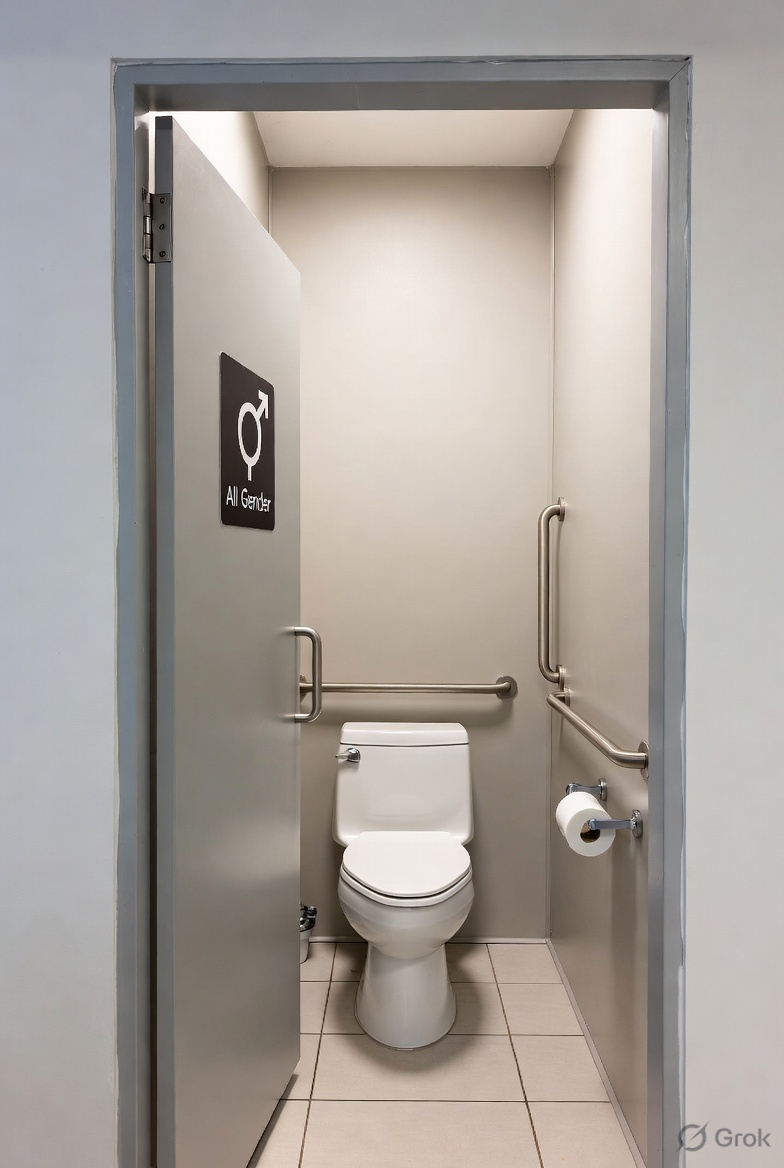
Single-occupant all-gender accessible sanitary facility interior, featuring WC, handbasin, sanitary disposal bin, grab rails, full-height partitions, and clear signage
The NCC 2025 preview, released by the Australian Building Codes Board in early February 2026, introduces a valuable optional Deemed-to-Satisfy (DTS) pathway in Volume One, Part F4, for all-gender sanitary facilities. This allows building owners and designers to incorporate all-gender compartments alongside traditional male and female facilities in Class 2 to 9 buildings, such as offices, retail centres, schools, community venues, and multi-residential developments.
The provision uses clear substitution rules to maintain total fixture counts while promoting inclusivity:
- For setups requiring only 2 closet pans (one male, one female), both can become all-gender.
- For 3 pans or urinals total, one all-gender facility can substitute, as long as at least one male and one female remain.
- For 4 or more fixtures, up to half (balanced equally between male and female quotas) can be converted to all-gender, ensuring that mandatory female facilities with sanitary product disposal remain prioritised.
Each all-gender compartment must be single-occupant, equipped with a WC, handbasin, sanitary disposal, and full-floor-to-ceiling privacy partitions to ensure safety, dignity, and hygiene. Access comes from non-gendered circulation spaces.
This update enhances inclusivity for gender-diverse users, including non-binary, transgender, and other gender-diverse individuals, while supporting broader needs such as families with children, caregivers of all genders, and people requiring assistance. It aligns with universal design principles and complements existing accessible sanitary requirements under AS 1428 and NCC provisions.
Building owners and developers gain real advantages. All-gender options reduce queuing times by sharing capacity more efficiently among users, based on evidence from queueing studies (e.g., Ghent University research showing that unisex/shared facilities can cut women's average wait times from over 6 minutes to under 1.5 minutes, with overall improvements of up to 63% in balanced layouts). Shorter queues improve user satisfaction, event flow in venues like shopping centres or community buildings, and overall amenity experience for tenants and visitors.
This flexibility can also optimise space and costs in design, as efficient fixture use avoids over-provisioning while meeting code minima. For Co-Living housing or adaptable housing projects, these options support person-centred privacy and dignity in shared or multi-occupant settings, especially when paired with accessible features.
In NSW, the optional DTS pathway simplifies compliance without needing Performance Solutions for all-gender provisions (previously common). It lets architects deliver forward-thinking, equitable designs that attract diverse tenants, boost reputation for inclusivity, and future-proof buildings.
Mid North Coast specialist Alexandra (Sandy) Gray brings practical expertise in inclusive design, audits, and adaptable housing. Her local knowledge helps integrate these provisions into projects for compliant, user-focused outcomes that enhance accessibility and reduce operational hassles like long queues.
What the NCC 2025 Preview Means for Accessible and Inclusive Building Projects in NSW
What the NCC 2025 Preview Means for Accessible and Inclusive Building Projects in NSW
The NCC 2025 preview, released by the Australian Building Codes Board on 1 February 2026, gives an early glimpse into the next edition of the National Construction Code. Jurisdictions can adopt it from 1 May 2026 onward, but exact dates vary by state and territory. Until then, stick with the current NCC (NCC 2022, including any amendments like Amendment 2 referencing the 2021 AS 1428.1 edition).
The preview targets practical upgrades in safety, performance, and usability, especially for commercial, multi-residential (Class 2+), and non-residential buildings. Highlights include:
- Stronger water management in Volume One Section F to cut water ingress risks.
- Better carpark fire safety.
- Enhanced commercial energy efficiency in Section J, with improved lighting controls and mandatory solar PV for some buildings.
- Improved condensation controls, including adjusted ventilation for certain small roofs.
- Optional all-gender sanitary facilities in Part F4.
- Refinements to structural reliability, fire safety Performance Solutions, and governing rules (plus a new register for alternative documents).
Accessibility stays rock-solid. No major shifts hit Section D (Access for people with a disability) or AS 1428 references. The Livable Housing Design Standard (in Parts G7 and H8 for dwellings) holds steady, keeping alignment with the Premises Standards. This means reliable rules for accessible apartments, homes, and public buildings.
For NSW accessible and inclusive projects, this preview brings welcome stability. The Premises Standards and state planning controls remain unchanged, so compliance stays straightforward. In Specialist Disability Accommodation (SDA) under the NDIS, no direct changes affect the SDA Design Standard (Edition 1.1, 2019) or NCC accessibility clauses. Person-centred, robust features for high-support or fully accessible dwellings continue as before.
Indirect wins come from better waterproofing and moisture management in multi-residential builds. These boost long-term durability and indoor quality, which benefit SDA occupants and adaptable housing (AS 4299) alike.
This consistency lets architects and developers plan confidently. Integrate universal design early, avoid surprises, and focus on value-adding solutions.
In regional NSW like the Mid North Coast, Alexandra (Sandy) Gray's hands-on expertise in audits, adaptable housing, and inclusive design helps deliver compliant, practical outcomes tailored to local sites.
Understanding Makita v Sprowles: Why Every Access Report Must Meet These Standards in Australian Courts and Tribunals
Understanding Makita v Sprowles: Why Every Access Report Must Meet These Standards in Australian Courts and Tribunals
Architects, developers, certifiers and access consultants in Australia frequently find their work tested in disputes under the Disability Discrimination Act 1992 (Cth), National Construction Code (NCC) compliance reviews, NDIS Specialist Disability Accommodation (SDA) assessments, or NCAT proceedings. When those disputes reach a hearing, the key evidence is almost always an expert access report. One landmark decision still governs whether that report will be admitted and carry weight: Makita (Australia) Pty Ltd v Sprowles [2001] NSWCA 305.
The facts of the case in plain English
Ms Sprowles slipped on concrete fire-escape stairs at her workplace in Gladesville. She sued her employer for failing to provide a safe means of access. The trial judge accepted expert evidence from a physicist that the stair treads were dangerously slippery. The NSW Court of Appeal overturned the verdict. The decisive reason? The expert’s report and testimony failed to explain how he reached his conclusions in a way the court could test.
Heydon JA (as he then was) delivered the leading judgment and laid down the now-famous requirements for admissible expert opinion evidence.

The seven Makita principles every access consultant must satisfy
For an expert report to be admissible under section 79 of the Evidence Act 1995 (NSW) and its equivalents elsewhere in Australia, we foresee that the following must be clear on the face of the report:
- There is a recognised field of specialised knowledge (in our case: accessible built environment, Australian Standards AS 1428 series, NCC Performance Requirements, DDA, SDA Design Standard, MS 1184:2014 in Malaysia, etc.).
- The witness has demonstrated expertise in a specific aspect of that field through identified training, study or experience.
- The opinion is wholly or substantially based on that specialised knowledge.
- All facts “observed” by the expert (site measurements, photographs, as-built drawings, level surveys) are identified and proved.
- All assumed or accepted facts (client-provided documents, instructions, historical plans) are explicitly stated.
- Those facts form a proper foundation for the opinion.
- The report must demonstrate the intellectual process: exactly how the expert’s specialised knowledge is applied to the facts to produce the opinion.
In short, the court or tribunal must be able to follow the expert’s reasoning step by step without having to guess or cross-examine first.
Why Makita remains critical for disability access work in 2026
- DDA complaints, SDA funding disputes and NCC Performance Solution assessments are almost always determined on expert evidence.
- Tribunals and judges routinely strike out or give zero weight to “bare ipse dixit” reports that simply state “this is non-compliant” without measurements, photographs, calculations, or transparent reasoning.
- The Uniform Civil Procedure Rules 2005 (NSW) Schedule 7 Expert Witness Code of Conduct reinforces Makita. Our reports must also comply with that code.
How Sydney Access Consultants ensures every report is Makita-compliant
As Qualified Access Consultants (ACAA members) and registered architects with decades of experience, we build Makita compliance into every deliverable:
- Qualifications and relevant experience are stated, with specific references (e.g., Diploma of Access Consulting, contributions to AS 4299, SDA Design Standard projects, and current NCC Volumes 1 & 2).
- Every site visit is documented with dated photographs, digital inclinometer readings, laser measurements and level surveys.
- All assumptions are listed in a dedicated section (e.g., “Client confirms the provided DA drawings are as-built”).
- Opinions follow a clear structure: Relevant NCC Performance Requirement → Applicable Deemed-to-Satisfy Provisions or Performance Solution pathway → Measured facts → Application of specialised knowledge → Conclusion.
- Performance Solutions include full justification, reference to relevant Australian Standards and, where required, fire-engineer or structural input.
This approach has seen our reports accepted without challenge in the Supreme Court, L&EC, District Court, NCAT, and in SDA assessments and SDA administrative appeals.
Practical tips for architects and developers
- Brief your access consultant with the same care you would brief counsel.
- Provide complete as-built documentation and confirm assumptions in writing.
- Insist on a draft report that you can review for factual accuracy before finalisation (never for opinion).
- Choose a consultant who routinely gives evidence. Their reports are written with the witness box in mind.
In an era of increasing enforcement of accessibility obligations — from NDIS SDA rollout in NSW and Perth to anticipated stronger PwD Act enforcement in Malaysia — a robust, Makita-compliant access report is not a cost; it is the strongest insurance against costly appeals and overturned approvals.
At Sydney Access Consultants we prepare every audit, SDA design review and Performance Solution exactly to this standard — because we know the difference between a report that survives cross-examination and one that does not.
Overview of Access Consultants' Roles
Understanding the Role of Access Consultants in Australia: Ensuring Inclusive and Compliant Built Environments
In today's evolving architectural landscape, access consultants play a pivotal role in creating spaces that are truly inclusive for everyone, including people with disabilities. As specialists in disability access standards, they bridge the gap between design innovation and regulatory compliance, promoting universal design principles to eliminate barriers in buildings, public spaces, and services. Rooted in key Australian legislation such as the Disability Discrimination Act 1992 (Cth) and complementary state laws, their expertise ensures adherence to the National Construction Code (NCC) and associated standards. This guide explores the distinct responsibilities of access consultants, highlighting how they differ from architects and contribute to accessible design across Australia.
Unlike architects, who focus on creative design authorship, urban planning, and overseeing construction projects, access consultants deliver specialized advisory, auditing, and certification services. Often acting as independent third-party experts, they emphasize regulatory compliance and equitable access, helping to avoid discrimination claims while enhancing usability for all users.
Key Roles and Responsibilities of Access Consultants
Drawing from the professional standards of the Association of Consultants in Access (ACA) and the accessibility provisions in the NCC (current edition: NCC 2022, Volume One, Section D – Access and Egress), access consultants undertake a range of targeted functions. These roles are essential for developers, builders, and governments aiming to meet Australia's stringent disability access requirements. Below, we outline the primary responsibilities:
- Compliance Audits and Assessments Access consultants perform thorough audits of existing structures, design plans, or new developments to verify alignment with core standards like AS 1428.1-2009 (Design for Access and Mobility – General Requirements for Access – New Building Work) and the Disability (Access to Premises – Buildings) Standards 2010. This involves on-site inspections, detailed reviews of architectural drawings, and pinpointing issues such as inadequate ramp gradients, insufficient door clearances, poor tactile signage, or non-compliant bathroom configurations. By identifying these early, they help prevent costly rectifications and ensure buildings meet NCC Clause D3.1 (Access for People with a Disability).
- Advisory and Consulting Services Providing expert recommendations on inclusive design is at the heart of an access consultant's work. They advise on performance solutions under NCC Clause A2.2 (Evidence of Suitability) when full compliance isn't practical, incorporating universal design principles to support individuals with mobility, sensory, or cognitive impairments. This consultative input often occurs during the initial design phases, collaborating with architects and developers to integrate features like level entrances, wide corridors, and adjustable fixtures. The ACA underscores this as a supportive role, distinct from an architect's overarching design accountability.
- Certification and Reporting In niche areas such as Specialist Disability Accommodation (SDA) under the National Disability Insurance Scheme (NDIS), accredited access consultants issue formal certifications. These confirm adherence to the NDIS SDA Design Standard (current edition: Edition 1.1, issued 25 October 2019), acting as a third-party verification similar to a building surveyor's endorsement. Accreditation is separate from architectural registration, focusing on specialized knowledge in disability access. Reports may also include performance-based design briefs, ensuring projects align with human rights obligations and avoid potential breaches of the Disability Discrimination Act.
- Education and Training Access consultants frequently conduct training programs for architects, builders, facility managers, and stakeholders on accessibility best practices. These sessions cover updates to standards like AS 1428 series and NCC amendments, fostering a culture of inclusive design. By sharing real-world case studies, they empower professionals to proactively address access needs, reducing reliance on retrofits and promoting long-term compliance.
- Advocacy and Policy Development Beyond project-specific work, access consultants contribute to broader policy advancements. They provide input on revisions to standards, such as potential updates to AS 1428 or NCC clauses, and advocate for improved public access. Collaborations with bodies like the Australian Human Rights Commission result in guidelines that emphasize human rights over purely aesthetic or structural concerns, reinforcing their role as champions of equitable environments.
Why Choose an Access Consultant for Your Project?
Engaging an access consultant early in your development process can significantly enhance project outcomes. In Australia, where the NCC mandates access provisions for Class 1b to Class 10 buildings (as per Clause D3.0), their expertise minimizes risks associated with non-compliance, such as legal challenges or funding denials for NDIS-related projects. For instance, in robust SDA designs, consultants ensure features like reinforced walls and automated systems meet participant needs while complying with Victorian guidelines on person-centred robust SDA (as outlined in Homes Victoria's resources).
At Sydney Access Consultants, we specialize in delivering these services with a focus on practical, innovative solutions tailored to Australian standards. Our team, including qualified experts with backgrounds in architecture and disability access, helps clients navigate complex requirements from Sydney to Perth and regional areas like the Mid North Coast.
Frequently Asked Questions About Access Consultants
- What is the difference between an access consultant and an architect? Access consultants focus on compliance and inclusivity audits, while architects handle holistic design and project management.
- How do access consultants support NDIS SDA projects? They provide certifications and design reviews to ensure compliance with the NDIS SDA Design Standard, promoting safe and accessible living spaces.
- Are access consultants required for all buildings? Under the NCC, access provisions apply to most public and multi-residential buildings, making consultants invaluable for audits and advice.
By integrating access consultants into your team, you not only meet legal obligations but also create spaces that empower all users. For more insights into disability access standards in Australia, explore our resources on universal design and NCC compliance.