Articles
Disabled Access Apartment Standards
There are numerous standards that apply to new apartment developments in NSW.
The NSW Gov have implemented the Apartment Design Guide which requires diversity in apartment design to accomodate the 20% of our population who are living with disabilities. Councils too have recognised that there is an ageing population that faces access challenges. Indeed, so many people make up the demographic of over sixty fives that it is recognised that home care will be the go to retirement plan, usurping Retirement Villages. The future will see home owners seeking to modify their dwellings to adapt to ageing and frailty, which can be done discretely and without devaluing the usefulness of the property to future owners.
There is in NSW, and will continue to be a massive imbalance in the available accessible or adaptable homes suitable for this ageing group.
The Savvy Councils have insisted on a higher proportion of "adaptable housing" and "Livable housing" in consumer derived apartment developments. Often these measures are in addition to the State Government minimums.
We are regularly assessing developments for compliance with:
- AS 4299 Adaptable Housing Standards
- Livable Housing design Guidelines
- Senior's SEPP housing
- AS 1428.1 access throughout the common areas of class 2 developments.
These planning regulations often compete and contradict, so we have developed clear method of assessment to guide developments through the minefield of access requirements and regulatory controls.
Disabled toilet regulations in NSW
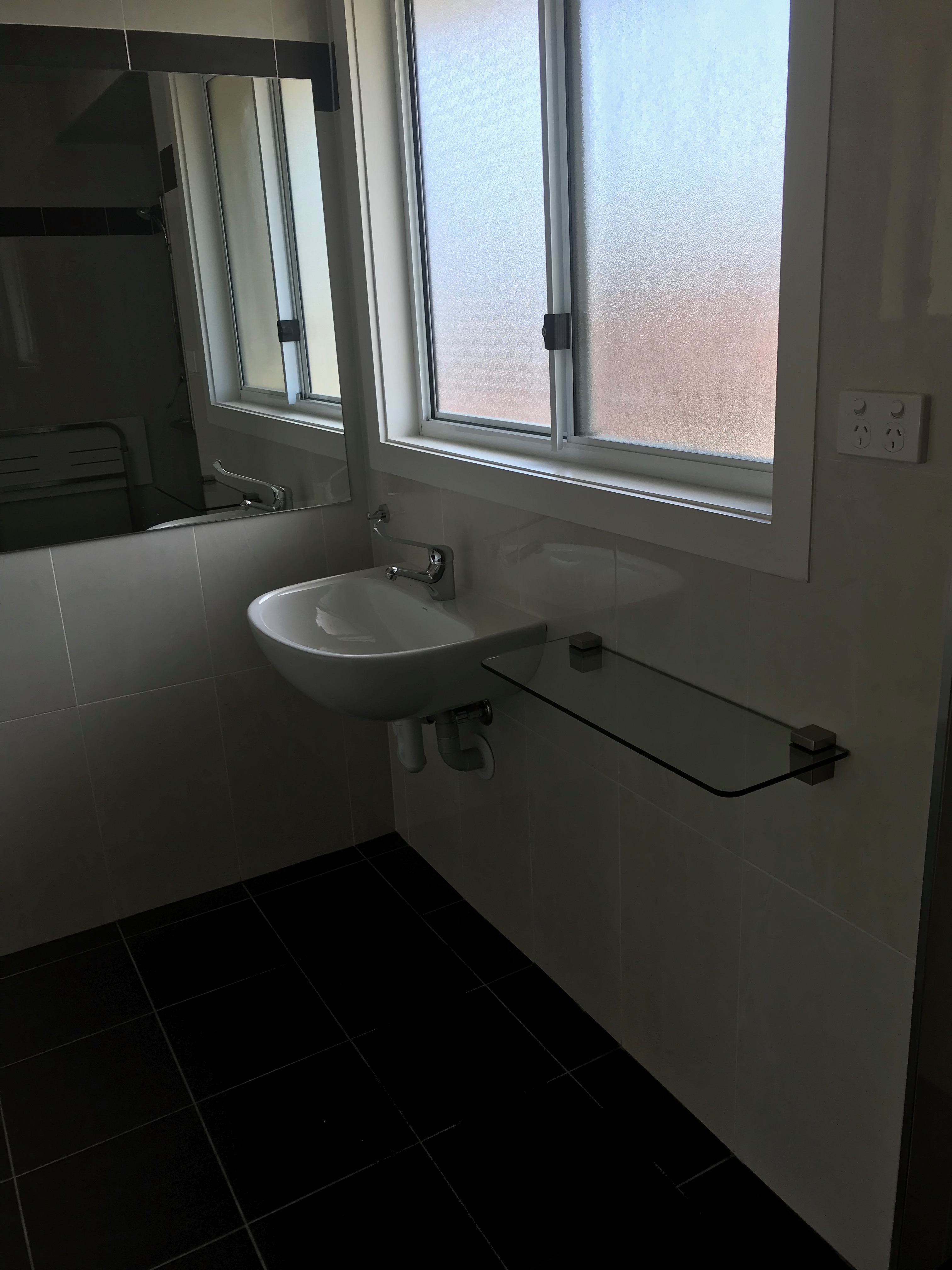
You’re a tenant and you’re establishing a new business, a restaurant for example, in a building that is required to be accessible, and you’re wondering about that new toilet. Should it be accessible? Where do I start? What are the regulations for a disabled toilet in NSW?
Don’t get caught out. In our restaurant example, the building code in NSW requires accessible sanitary facilities where there are 20 or more occupants in the building. If your building has accessible facilities for use by your patrons, then you’re in luck. Otherwise, you'll need to provide an accessible WC capable of compliance with the Australian Standards 1428.1. There are very few exceptions established by an examination of the Disability access to Premises Standards 2010, which we can assess only by examination of the peculiar circumstances of your development.
Depending on the door location and plan layout of fitments, the space required for circulation space within an accessible toilet must be at least, say 2640 x 2100mm, clear of wall linings, tiles and so on.
There are also mandatory inclusions for instance:
- An accessible pan & seat
- Grab rails and back rest
- A vanity basin without plumbing protruding underneath and onto the floor
- A shelf
- A coat hook
- A door with a minimum clear opening of 850mm (a 920 door leaf might just achieve that depending on the installation technique and thickness of the door).
- Adequate lighting
- A non slip floor surface
It’s a best case scenario to send us your plans prior to the commencement of construction so that your layout can be certified as capable of compliance prior to your commencement. We get calls from people who have been rejected by there certifier on completion, every week. You don’t want to be that person.
Motivation to provide Inclusive Design in all your projects
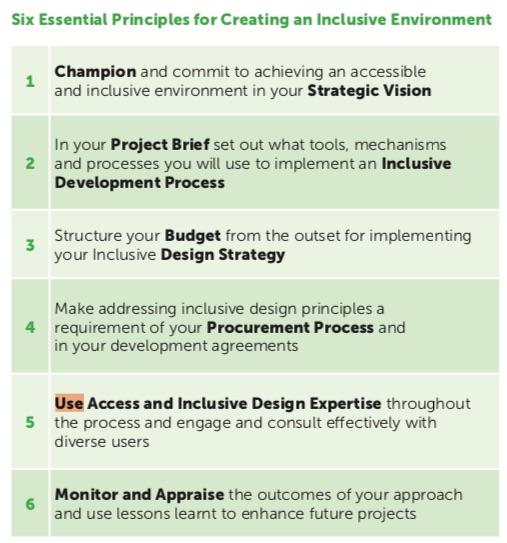
The Construction Industry Council (CIC) is the UK's representative forum for the professional bodies, research organisations and specialist business associations in the construction industry. It has published a new "Essential Principles Guide for Creating an Accessible and Inclusive Environment" which aims to support, guide and motivate clients, developers and contractors to achieve high standards of access and inclusion in all their projects.
If leaders in the construction industry champion inclusion from the outset, those employed to design, construct and manage projects are more likely to achieve high quality accessible and inclusive developments.
Building owners and developers will greatly benefit by generating a development that will:
- Place people at the heart of the design process
- Acknowledge diversity and difference
- Offer choice where a single solution cannot accommodate all users
- Provide for flexibility in use
- Create an environment that is convenient and enjoyable for everyone to use.
Inclusive design does not need to increase costs. If planned and integrated into the client’s business case from the outset it can be cost neutral. Redesign and post completion retrofitting can be very expensive, can lead to compromise and inefficiencies, and even legal redress if discrimination is the result. Access by design will generally provide a much improved user experience where independence and dignity can be reliably maintained, compared to relying on management arrangements, such as the need for a member of staff to operate a portable ramp.
Sydney Access Consultants are committed to removing the barriers to access, one step at a time.
For full details see CIC website.
Accessible Jakarta - A unique Smart City in the making
.jpeg)
The history of Jakarta is fascinating. It was the home of the Dutch East India Company for a few hundred years and the Dutch influence remains obvious in much of its historic architecture. The population is a beautiful mix of multicultural influences developed over centuries to the uniquely Indonesian culture that remains today.
Jakarta is a vibrant modern city with a population estimated to be over 12 million inhabitants. At street level, an Australian Sydney resident would think the streetscape is total chaos. It's a great experience. There are people riding motorbikes everywhere, seemingly without restriction, street food appear to line every road obstructing the footpath where there is one, and where there are no food stalls, or street hawkers, there are motorbikes and vehicles parked. Stepping out into this chaos means you need to look both left and right for oncoming motorcycles. Crossing the road is even more challenging, weaving in and out of bikes and vehicles, jumping and hopping and scuttling out of harm's way.
A city centre bus network, in an effort to avoid all this footpath activity, and provide a peaceful spot to await a bus, has been installed in the centre of the road on an island platform about a metre above the ground. It is accessed by lift or otherwise by stairs from footpaths on each side of the road. Special buses with doors half way up the sides use the middle lane of traffic, far from the majority of the motorcycles, that cling to the left lane, most of the time. It's more of a vibe than a rule. There are much smaller buses that pick up pedestrians from the footpath, and these, I suppose, travel shorter distances in and around the city centre.
How can such a hostile environment be made accessible for people who live with disabilities? A person living with disabilities must find their way through the chaos to the lift at footpath level. That's currently an impossible task in most instances.
Other Asean nations have considered this by providing sky bridges and a network of elevated pedestrian ways. In Sydney, we've got a network of pedestrian tunnels all over the city. None of these expensive solutions are particularly relevant to Jakarta, because of its large sprawling city, high tropical rainfall and subterranean swamp like foundations.
The Old City precinct of Jakarta provides both a clue and a role model. It excludes all motor vehicles. Street hawkers are restricted to create a pedestrian precinct that is enjoyed by everyone, year round. People ride pushbikes, push prams, stroll in family groups, enjoy the museums, free of the chaos that represents the typical Jakarta streetscape.

Use the Old City as a model solution? It is possible to create small local and inclusive pedestrian environments by planning pedestrian precincts dispersed widely throughout the city. These need not be large areas or cause great disruption, but are small community based pockets of space involving vehicle exclusion zones. Such community centres could readily be linked by small but accessible bus transport systems, linking to the larger bus and rail infrastructure that exists across Jakarta.

One of the difficulties that communities in Australia seem to have, is that we've developed design standards for accessibility targeting the Universal person to try and remove a wide range of access barriers. This Universal person is someone who does not actually exist.
Humans have a great capacity for empathy, but to empathise, putting oneself in the shoes of another, one first has to try and put a face to that thoughtfulness. Well, that's at least what I do. When I think of this universal person with a disability, I imagine my dear old father, 90 years young, deaf in one ear, difficulty seeing things in low light levels, challenged by steps, out of breathe by long walks, moving from chair to chair for support, occasionally having difficulty putting words together that used to come so naturally, accompanied by my young niece who has three children, one walking independently, two in the pram, the four of them are easy for me to imagine, and between them they know three words in Indonesian. They are catching a bus to the Jakarta City centre to explore all that it has to offer. If we can design our smart cities for them, then most of the barriers for people living with disabilities will fall away.
Sydney Access Consultants are removing the barriers to disability access one step at a time.


How can you live at home, longer?
Baby boomers across Australia are thinking about, or have commenced their retirement. As beneficiaries of prosperity like no generation before them, they're making lifestyle choices from an empowered position. They're healthier than previous generations and can expect to live longer than past generations. Their new found freedom provides access and opportunities to travel the world and actively participate in the lifestyle of their dreams.
This freedom is not something that anyone would wish to relinquish just because of sudden health changes for instance, or untreatable degenerative conditions that accompany ageing. Baby Boomers will likely choose to avoid the move into assisted living or nursing facilities, instead, hoping to stay as long as possible in the dwelling of their choice, with all the creature comforts and few of the accompanying chores.
That's where Universal Housing concepts come into their own. That is the reason that the Livable Housing design Guidelines were conceived and introduced into 20% of all new apartment buildings in NSW, since the Introduction of the State Environmental Planning Policy 65 - Design Quality of Residential Flat Development and the accompanying Apartment Design Guide. What's so special about this type of housing?
- Improved accessibility and comfort
- promises higher levels of independence for a person with limited mobility
- Ease of functionality
- Adaptable design characteristics that can change when your needs change
- provide high levels of independence for the individuals within the residence
- provide inter-generational spaces for extended family interactions
- provided with appropriate and adaptable technology
- virtually step free with essential elements on one level
- thoughtful vertical transport systems pre-empted
- generous door widths, bathrooms, bedrooms and living areas to pre-empt future circulation space requirements with limited mobility
- non-slip finishes, good lighting levels, appropriate luminance contrasts and cost effective environmental management systems
Typically a suitable home design will consider that you will have health and fitness challenges and a reduced interest in maintaining the home. You'll be more interested in pursuing interests away from home and your children will no longer be living with you, but will visit, potentially en-masse, so you're not thinking of downsizing, necessarily. Indeed, you may be considering a multi generational home when children move back in with their spouse and your grandchildren! You may be thinking that you need to care for your own parents in your home as they age. These circumstances all weigh heavily on your decisions as to whether you relocate or renovate. Whether you build anew or purchase a home in a new community or gated retirement village. And, all of these decisions will be complicated by your desire to conserve your retirement funds so that you can live sustainably.
As architects specialising in Universal Design concepts, Sydney Access Consultants can guide your decisions from an informed position. Ask us to assist you to prepare your architect's brief, and/or review your architect's plans from an accessibility perspective. That's what we do, professionally, at Sydney Access Consultants.
Please get in touch if you've got any questions.
Kind regards

Gary Finn dated 29 August 2018
(Cert iv Access Consulting)
Architect Principal #5774 (NSW)
Sydney Access Consultants
http://www.sydneyaccessconsultants.com.au
Shop 7/438 Forest Road, Hurstville NSW 2220
Phone (02) 95863111 Mobile 0414 414101
Member of Master Builder's Association;
Associate of the Australian Institute of Architects;
Associate of the Association of Consultants in Access, Australia
Disability Toilet Setout in NSW
You've probably landed here because you're trying to figure out how to set out your toilet pan for a Unisex Accessible Toilet facility in your commercial premises.
The Australian Standards AS 1428.1 establishes the requirements under the Building Code of Australia, so the provisions are mandatory, with limited exceptions. The exemptions can arise by way of the Disability (Access to premises) Standards 2010 from which the BCA requirements are derived. However, the exceptions are rare. If you think your circumstances are exceptional, give us a call.
Critical dimensions for toilet set out relate to circulation space for the 90 percentile wheelchair. If you're designing for a particular person, as opposed to this mythical universal person, then the standards may not apply at all. You ought properly be considering the needs of that individual. This exception does not apply to commercial buildings, but you ought still make reasonable adjustments necessary for an employee, for instance.
The toilet pan is not a standard height. It is usually higher than most toilet pans, so that it is easier to transfer from a wheelchair to the pan, or easier for say, an elderly person, to stand up from a seated position.
It's appropriate that the toilet be discernible by a person who might have poor eyesight. Use a luminance contrast between the pan and the wall on which it is mounted, for instance, or more properly, a toilet seat that provides luminance contrast to the pan.
There are critical circulation spaces to the side and in front of the toilet pan which must be satisfied.
For a full assessment of your project, prior to installation preferably, give me a call.