
 Sydney Access Consultants Promoting participation that is interwoven into everyday life
 Issue 13: Acessible WC's
- ROOT
- Articles
- Sunday, 08 September 2024 16:21
- Sunday, 16 August 2015 11:44
- Hits: 5671
Extract from the Human Rights Commission website: © Australian Human Rights Commission
ISSUE 13:
Accessible WC’s
Importance of the feature
Accessible WC’s are often built and certified as meeting the technical standards, however, more often than not they fall well short of those requirements.
There are three critical areas that need to be applied to the design and construction of accessible WC facilities, these being;
- Doorway circulation spaces external to the door and within the facility clear of fittings and fixtures.
- Internal circulation space to enable wheelchair manoeuvrability for safe transfer and use of fixtures.
- Reach ranges to fittings and fixtures.
Failure to provide adequate doorway and internal wheelchair circulation and correct placement of components means the facility cannot be used by many people with physical disabilities.
For people who use a wheelchair, the circulation spaces into and within the accessible facility is critical if they are to be able to carry out a safe transfer from their wheelchair to the pan.
Users of the accessible facilities need to carry out a range of transfers onto the pan depending on their particular disability and what they consider is the best method to transfer.
Approximately 1/3 will carry out a side transfer from the side of the pan, which requires aligning themselves with the seat on the pan. Another 1/3 will carry out a frontal transfer, which requires aligning themselves to face the front of the pan and then pull themselves onto the pan facing the cistern. The remaining 1/3 will carry out a half frontal/side-on transfer which can vary depending on the method of transfer chosen by the person. (See AS1428.1 – Supplement [1990] for more details).
The area of the circulation space is critical to allow these transfers to take place, as is the correct location of the grab rails because of limitations of reach ranges and varying levels of ability.
It is important that the fit out does not result in the intrusion of fittings into the doorway circulation spaces and toilet pan circulation area, except where allowed by the technical standards - for minor overlapping of washbasins.
Reach ranges and location of fixtures if installed in accordance with the technical standards will allow the majority of people to use these facilities in relative comfort and not have to struggle to reach taps, toilet paper holders, hand dryers, grab rails, shelves and other fixtures.
Clearances above grab rails are important so that a person may use the wall adjacent to the grab rails for support if needed.
Code requirements
The Building Code of Australia (BCA) sets out in F2.4 the requirements for the number of accessible WC’s to be provided and under clause D3.3(a)(iii).refers to and requires compliance with AS1428.1 for design and fit out criteria.
AS 1428.1 Clause 15 sets out the criteria for fit out and dimensioning and provides various circulation space diagrams which can be used in template form to assemble the design.
These must be used in conjunction with doorway circulation spaces and include a clear plan of whether the door will swing outwards or use another mechanism for emergency access.
Clause 15 also provides several diagrams for accessible shower configurations which can be integrated with the toilet pan and other fittings.
Achieving best results
To be effective accessible WC’s and showers must be within the minimum requirements set out in AS1428.1. This is achieved by ensuring:
- The location of the doorway and swing (or sliding) will enable appropriate area to operate the door. The door must also facilitate emergency access and when using swinging doors either by swinging the door outwards or installing a doorway mechanism to allow the door to swing outwards by using a pivot hinge and associated fittings.
- Provision is made for the correct dimensioning of circulation spaces without any intrusions such as the basin obstructing the doorway circulation space when exiting or the waste pipe from the basin intruding on required space for footplates.
- Dimensioning is taken from finished surfaces finishes, not set outs, with adequate allowances for finishes in the structural set out.
- Location of components is in accordance with the standard.
- Any minor permissible intrusions into the pan circulation space are in accordance with the standard.
- Heights and reach ranges are as per the standard.
- Vertical grabrails in showers are capable of meeting the required force specifications of 1100 N. The installation of light-weight plastic vertical grabrails in showers is not likely to meet this requirement.
- Installing shower hoses long enough to allow users sitting on a fold down seat to access and use them. For example, installing a 1200mm-1500mm length shower hoses attached to a 1800mm+ height water outlet may not provide adequate useability. Either a longer hose is required or a lower water outlet.
- Heavy door closers requiring forces greater than 19.5 Newtons do not cause difficulties for people opening a doorway. A low-tech alternative of using self-closing gravity hinges can be a better solution in many cases.
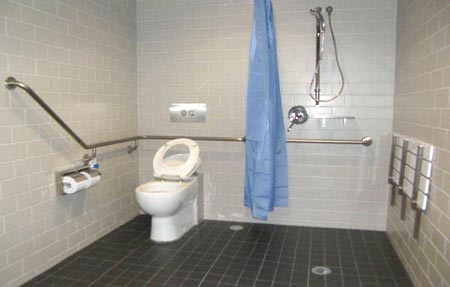
Photo 1 shows a good example of correct installation of toilet and shower fittings
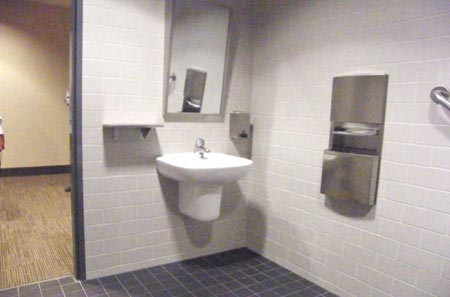
Photo 2 shows a good example of the installation of a washbasin and other fittings, including a shelf as required by Table F2.4 of the BCA, note that tilt mirrors are not a requirement of AS1428.1.
Common problems and misinterpretations
1. Intrusions into required pan circulation space.
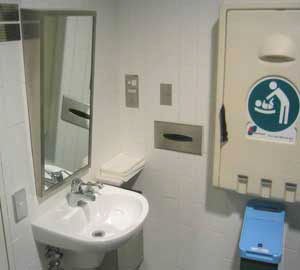
Photo 1
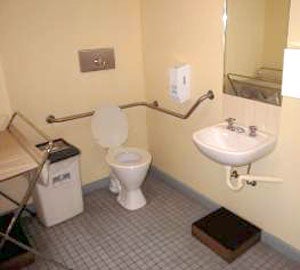
Photo 2
Photos 1 and 2 show intrusions into the required circulation space for the pan.
2. Incorrectly located fittings.
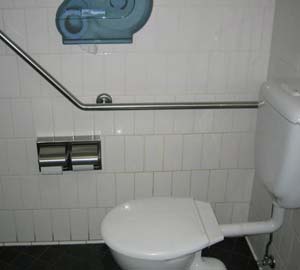
Photo 3
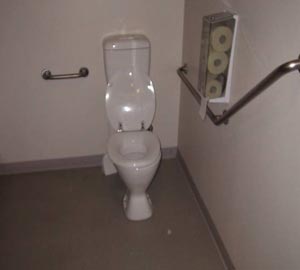
Photo 4
Photos 3 and 4 have a toilet paper holder above the grab rail, which does not allow users to take advantage of the side grab rail to use as support when rising from the pan.
Many users place their arm along the grab rail, which is supported by the rail and the wall. This assists them in rising off the pan and transferring back onto their wheelchair. The toilet roll holders above the grab rails do not allow users to carry out this procedure.
Correct location of the toilet paper holder is below the grab rail as was originally designed for in photo 3.
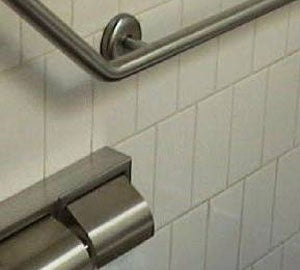
Photo 5
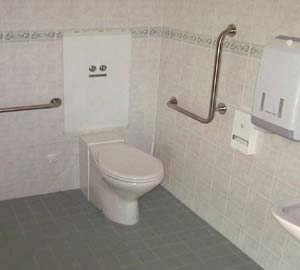
Photo 6
Photo 5 shows the wrong central fitting on the grab rail. They are attached to the side of the grab rail and not underneath it. The top 270° arc is required to be clear along the full length of the horizontal and 30° - 45° angled section of the rail. People have injured themselves when “grabbing” at the grab rail by catching their fingers on the central fixings.
Photo 6 shows the toilet paper fixture too far from the front of the pan, which requires users to lean forward to get the paper. People with limited upper trunk control may and have fallen off the pan whilst reaching for the paper in this location.
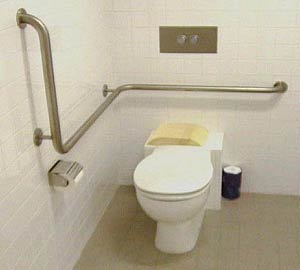
Photo 7
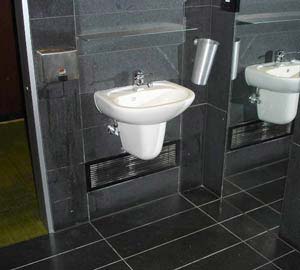
Photo 8
Photo 7 shows the correct location for the toilet roll holder and photo 8 shows the required minimum 300mm for the basin from the swing of the door thereby allowing enough circulation space at the door to open it when exiting.
3. Grab rails incorrectly located or wrong type used.
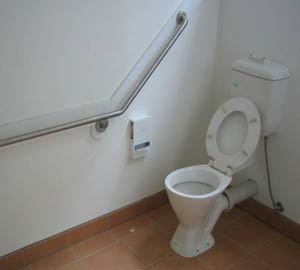
Photo 9
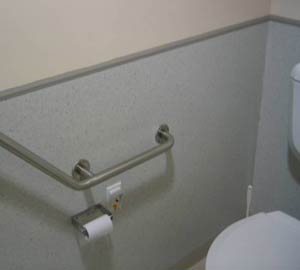
Photo 10
Photo 9 shows the handrail fitted totally the wrong way round and photos 10 and 11 have incorrect grab rails fitted as they do not extend back to within 50 - 60mm from the rear wall.
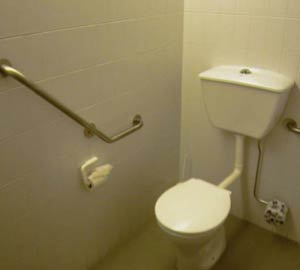
Photo 11
When carrying out a frontal transfer onto the pan, a person will pull themselves onto the pan by stretching out their arm to gain maximum purchase on the rail and then pull themselves forward.
If the grab rail does not extend back to within the 50 - 60mm from the rear wall they will not be able to comfortably pull themselves forward onto the pan as their purchasing power drops off when their arm is in the bent position.
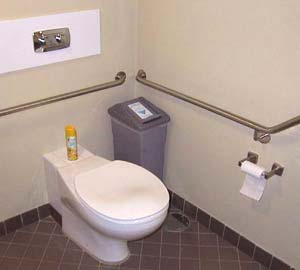
Photo 12
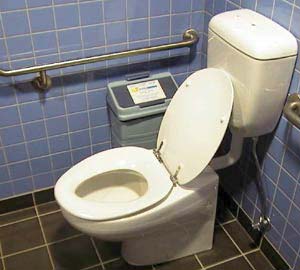
Photo 13
Photos 12 and 13 show correct type of grab rail used and fixed within 50 – 60mm of rear wall.
4. Ongoing management problems
While not a BCA building and construction issue one of the most frequent problems associated with accessible toilets are the barriers caused by inappropriate usage and management.
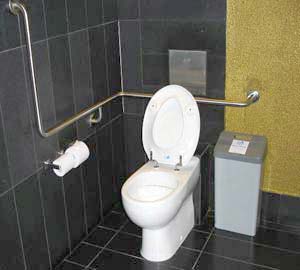
Photo 14
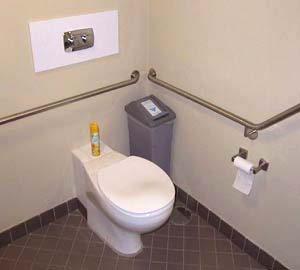
Photo 15
Photo 14 shows a sanitary napkin bin, which should be in the corner at the rear of the pan. The bins cannot be moved by many of the users of these facilities, if they do try to move them it is likely that they may be knocked over. There positioning restricts those users who wish to carry out a side transfer to the pan.
The bin in photo 15 is placed in the corner out of the way of users who can now carry out side, frontal or half frontal transfers without difficulty whilst also allowing the bin to be within reach of the pan.
Perhaps the most common problem, however, is the practice of using accessible toilets as store rooms as in photo 16. Apart from the use of the toilet as a storeroom this shows a particularly creative interpretation of AS1428.1 in relation to the grab rails!
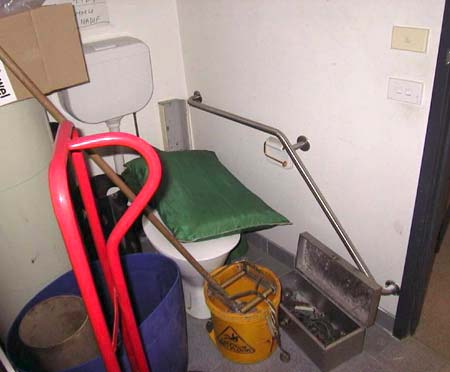
Photo 16